

Real Life Tested. Dad, Mom, Kid, and Occasionally Dog (and now Bunny 🐰) Approved.
We Tried It is run by the Hanna family in Fort Collins, Colorado: Chip, Jessica, Scarlett, and Teddy. We review the products that keep showing up in your feeds—e-bikes, men’s clothing, smart home gear, sleep tech, meal kits, travel stuff, kids’ gear, and the occasional gadget that promises to fix adulthood by Thursday. Our rule is simple: if we have not used it in real life, we do not pretend we have.
That sounds obvious. It is not. A shocking amount of the internet is stock photos, recycled spec sheets, and “best of” lists written by someone who has never wrestled the thing out of the box. We would rather publish slower and be useful. Radical concept, apparently.
Meet the We Tried It Family

Chip Hanna is Mr. We Tried It: the early adopter, spreadsheet maker, e-bike over-explainer, and person most likely to say, “I bought one so we can test it.” He has spent more than a decade comparing products the annoying way: buying them, using them, taking notes, finding the weird failure points, and then writing the review he wished existed before he clicked checkout.
Jessica Hanna is Mrs. We Tried It: the practical filter. She is less impressed by marketing claims and more interested in whether something actually makes family life easier. If a product looks great in a press release but becomes one more thing to charge, clean, fold, troubleshoot, or apologize for owning, Jessica usually spots the problem first. The scowl of disapproval is real. It has saved readers money.
Scarlett and Teddy are our built-in chaos lab. Kids are honest product testers because they do not care about brand positioning. They care whether the thing is fun, comfortable, durable, and not secretly annoying. For family gear, kids’ products, travel tools, food, and home stuff, their reactions matter because real homes are not photo studios. They have backpacks on the floor and somebody asking for a snack every seven minutes.
What “Actually Tested” Means Here

“We tested it” does not mean we skimmed Amazon reviews and copied the manufacturer’s bullet points. It means the product entered our life and had to survive normal use: school mornings, workdays, dog walks, Colorado weather, travel days, family dinners, laundry cycles, charging cables, bad instructions, and the general entropy of being alive.
For an e-bike, that means riding it beyond the pretty first impression: hills, range anxiety, brakes, storage, assembly, serviceability, whether it is terrifying with a kid on the back, and whether the company disappears the second you need support. For men’s clothing, it means wearing the pants, washing them, traveling in them, sitting in them too long, and asking whether they still look good after real use. For home products, it means asking whether they solve a problem or just create a new subscription with nicer packaging.
Sometimes a test lasts a week. Sometimes it lasts years. Our Pura coverage, clothing comparisons, sleep tech reviews, e-bike guides, grocery delivery comparisons, and meal kit rankings come from repeated use, not a ceremonial unboxing followed by affiliate links. Unboxings are easy. Living with the thing is where the truth gets weird.
Our Review Standards
- Hands-on first: We prioritize products we own, bought, borrowed, or used enough to have a real opinion. If a piece is research-based instead of hands-on, we say so.
- No pay-for-praise: Brands cannot buy a positive review. They can send a product. They cannot buy the verdict. Those are different things, and the difference matters.
- Affiliate links do not decide winners: We may earn a commission when readers buy through links, but the recommendation has to survive our actual experience first.
- Negatives go near the top: If something is overpriced, awkward, fragile, overhyped, or only right for a specific person, we try to tell you early. Nobody needs a 2,000-word scavenger hunt for the catch.
- We update when experience changes: Products change. Prices change. Brands get better or worse. When we learn something meaningful, we update the article instead of pretending the first draft was carved into stone.
Why So Many Reviews Are Positive
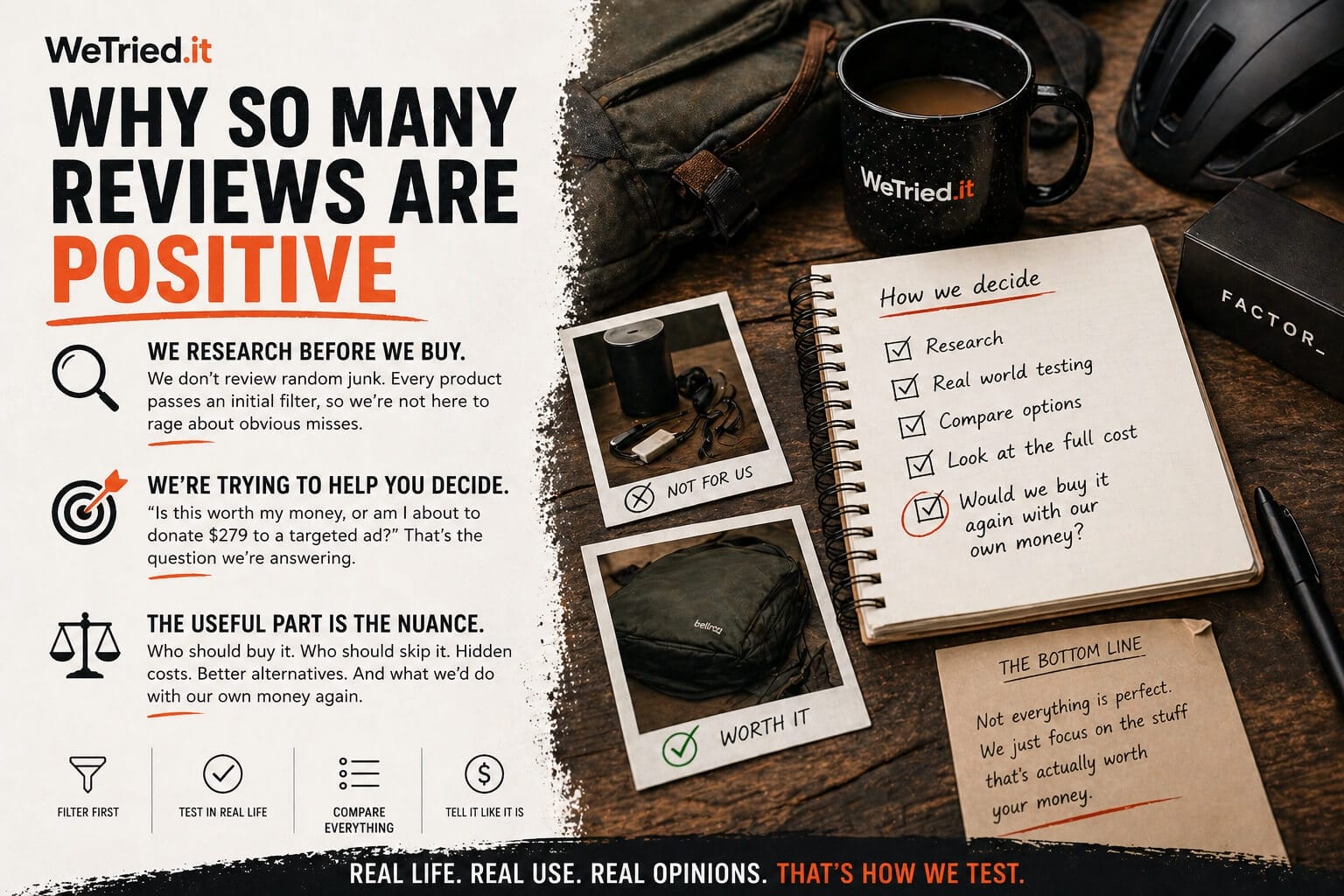
We get this question a lot. The answer is not that every product is magical. The answer is that we usually research before buying. We are not trying to fill the site with rage-clicks about obviously terrible products. We are trying to help readers make the same decision we were making: “Is this thing worth my money, or am I about to donate $279 to a targeted ad?”
That means many products we review already passed an initial filter. Even then, plenty of them disappoint. The useful part is the nuance: who should buy it, who should skip it, what the hidden costs are, what competing product is better, and what we would do if we were spending our own money again. Especially that last part.
How We Handle Free Products, Sponsorships, and Commissions

We Tried It uses affiliate links. If you click a link and buy something, we may earn a commission at no extra cost to you. That helps pay for hosting, testing, replacement parts, and the products we buy because curiosity is expensive. Very expensive. Suspiciously expensive.
When a brand sends a product for review, we disclose it where relevant and still judge it the same way: does it work, who is it for, what are the flaws, and would we recommend it to a friend who was paying full price? If the honest answer is no, the review needs to say no. If a brand wants guaranteed praise, they need an ad, not a review.
What We Know Best

Our strongest categories are the ones we use constantly: e-bikes and micromobility, men’s clothing and travel clothes, smart home gear, sleep technology, family products, kitchen tools, meal kits, grocery delivery, and practical “lifehack” products that claim to save time. We are not laboratory engineers. We are real-life testers with a high tolerance for comparison shopping and a low tolerance for nonsense.
That is why our reviews focus on everyday questions: Is setup painful? Does sizing run weird? Does the battery estimate lie? Is the app required? Will it survive kids? Is the cheaper version good enough? What would we buy again? These are not glamorous questions. They are the questions that actually determine whether a product becomes part of your life or ends up in the closet of abandoned optimism.
Our Promise to Readers

We will not be the biggest review site on the internet. Good. The internet already has enough giant sites ranking for things they barely touched. Our goal is simpler: be the review you read right before making a purchase because it feels like a knowledgeable friend saying, “Here is what I wish I knew first.”
If something is great, we will say so. If something is good but only for a narrow person, we will say that too. If something is a waste of money, we will try to save you from it. And if we get something wrong or your experience is different, we want to hear about it because reader feedback helps make the next update better.
How a Review Gets Made
Most reviews start with a real question in our house. Should we replace the second car with an e-bike? Are the expensive pants actually better than the cheaper ones? Can a smart diffuser make the house smell good without becoming another app we resent? Is the meal kit worth it after the promo code disappears? That question becomes the test plan, even if the test plan is just a Google Doc, a receipt, and Chip muttering about battery percentages.
Then we use the product like normal people. We compare it against what we already own, note the setup problems, track what breaks, look at total cost, and ask the unglamorous question: would we buy this again with our own money? If the answer changes after a few weeks or months, the review changes too. A product can be impressive on day one and annoying by day thirty. Day thirty matters more.
We also try to separate personal preference from useful advice. Chip may love a feature because it is nerdy. Jessica may reject it because it adds friction. Both reactions are useful, but neither one is universal. Good reviews explain the tradeoff clearly enough that you can decide based on your life, not ours.
Corrections, Updates, and Reader Feedback
We are careful, but we are not pretending to be infallible. If a spec changes, a brand fixes a problem, a product gets worse, or a reader spots something we missed, we want to know. The best version of We Tried It is not a museum of old opinions. It is a living record of what actually happened when real people used real products over time.
That is especially important in categories like e-bikes, apparel, smart home devices, and subscription services, where pricing, warranty terms, firmware, sizing, and product lines change constantly. We would rather update a recommendation than defend an outdated one. Stubbornness is not editorial integrity. It is just bad customer service with a thesaurus.
Questions? Corrections? A Product We Should Actually Try?
Send it our way. We are always looking for products worth testing, claims worth challenging, and reader questions that deserve a less lazy answer than “it depends.” We cannot test everything. We can test enough to help you avoid the obvious traps.